Book Author

Business 5.0, Campus 2024
The breakthrough for artificial intelligence (AI) is finally here. But doubts about this "cure-all" technology like ChatGPT are warranted.
In our new book, Thomas R. Koehler and I provide an assessment of current AI technologies, ruthlessly separating hype from reality. We equip business leaders with the tools to meaningfully implement AI in their companies:
"Business 5.0. The Practical Guide to Artificial Intelligence in Business – Opportunities and Risks", outlines seven steps for establishing viable AI projects in organizations, with concrete examples for various industries and business functions.
The focus is on implementing AI in a sustainable way that provides long-term value.
While AI promises exciting new capabilities, a measured, strategic approach is needed to realize its benefits while managing risks and limitations. This book offers practical guidance for business leaders to thoughtfully integrate AI and position their companies for the future.
"Business 5.0," published by Campus Verlag, is the second book that Thomas R. Köhler and I have co-authored together. As an established team of business partners and researchers, we pool our expertise in this new publication to provide valuable insights on implementing artificial intelligence strategies in organizations. With our previous experience collaborating and writing together, we are well-positioned to deliver an informative book that guides leaders on the strategic use of AI to drive business value.
Business 5.0
GetAbstract Revue
Review
AI is on everyone's lips. But what does it actually have to offer? How much is hype, and what makes sense? How do you get started? Digital specialists Thomas R. Köhler and Julia Finkeissen provide concrete answers. They explain the fundamentals, warn about risks, and demonstrate practical applications. They also give entrepreneurs and managers a practical 7-step plan for implementation in their own companies. Leaders who want to start using AI actively and purposefully are well served by this book.
Key Takeaways
- No company will succeed without the use of AI.
- AI takes over routine tasks and supports our decisions.
- Hallucinations, security risks, and gradual dumbing down are among the AI risks you must keep in mind.
- The use of AI has consequences that are socially and ecologically problematic.
- Test AI applications in a limited, pre-defined area.
- Train your employees and yourself in the use of AI, especially in prompt writing.
Summary
No Company Will Succeed Without AI
Software developers use AI to find bugs, consultants create presentations with it, and architects have it generate ideas for new buildings: It feels like everyone is already using AI somehow. But how does your company move from perceived anarchy to structured and meaningful use of this new technology?
One thing is certain: Your company will not be able to avoid using AI. Those who refuse to develop will soon be overtaken by the competition, because AI enables unprecedented productivity gains. An anti-AI stance also scares off your best people—those who are open to innovation and efficiency gains. These people will look for another job if they are not allowed to use AI at your company.
"The ball is in your court. AI is one of the most important topics of the decade when it comes to your company's future viability."
But what exactly are we talking about when it comes to AI? The hype started with the launch of ChatGPT in November 2022. Within just five days, OpenAI cracked the one million user mark with this offering. The technology that has been making waves since then, and on which ChatGPT and similar tools are based, is called generative AI. A user enters text or image prompts, and the AI then generates texts, images, or sound.
Behind the AI's output are so-called Large Language Models (LLMs). However, they are not really intelligent—they just appear to be. They simply string words together based on probabilities without truly understanding their content. ChatGPT is the best-known LLM-based tool, but the market is fiercely competitive and highly dynamic. Many new providers are expected to emerge, and a strong open-source movement is likely to develop.
AI Takes Over Routine Work and Supports Decisions
Experts agree that we are only seeing the tip of the iceberg when it comes to AI applications in business. But what AI can already do today is quite impressive. On one hand, it helps with everyday office work: It can draft emails and advertising copy, revise existing texts, create a meeting agenda, or summarize existing project notes clearly. All these applications will be integrated with other services in the future. Soon you will probably be able to ask AI to create an appealing PowerPoint presentation from an Excel spreadsheet. Many companies are also gaining initial experience with using AI as a chatbot for customer contacts, reducing response times and the workload of service center employees.
Those who think further will recognize countless other applications. AI can support purchasing by detecting impending shortages and price increases early or by creating market analyses. In HR, AI can draft job descriptions, references, and employment contracts. In marketing, AI often shines by simply accomplishing much more in less time than was previously possible. For example, US used car dealer CarMax had 5,000 different used car models described by AI—with the existing manual process, this would have taken about 11 years. At Munich radio station Gong 96.3, you can already create your own radio ad in just a few minutes using AI.
In the area of corporate leadership, AI is still used more hesitantly. Many CEOs use AI-generated information as support, but important decisions are still almost always made by humans—after all, there are legal issues that have not yet been resolved.
"AI as a data aggregator and decision supporter will be unstoppable."
But AI can also be very useful outside of offices. It can direct visitor flows at major events, tourist centers, and retail. In studios, it can create fashion designs and enable virtual try-ons of new collections. Finance, insurance, mobility, transportation, real estate, medicine: Virtually every industry is currently being transformed by AI, each in its own special way.
Not all of these developments are successful. For example, the self-published e-book market has been flooded in recent months with poorly made books obviously written by AI. And in some places, AI's potential even raises political-philosophical questions. Many look with concern at so-called predictive policing, where police use AI to prevent crimes before they happen.
Hallucinations, Security Risks, and Gradual Dumbing Down Are AI Risks to Watch
AI at any cost is the wrong approach. Anyone wanting to implement AI in their own company should definitely familiarize themselves with the risks and dark sides of the technology first. Among the most important problems are false results: No one guarantees that what an AI writes is accurate. In fact, AIs frequently "hallucinate" and invent sources or court rulings that don't exist. Anyone wanting to base important decisions on AI analyses must therefore thoroughly verify everything for accuracy. Equally problematic are deliberate fake content and propaganda. This is not so much about using AI itself, but about using its results. Employees must be aware that AI can now be used to maliciously generate information that appears deceptively real.
The area of copyright and data protection is also delicate. AI has made this already difficult topic even more complicated. Every company should work with recognized experts to be on the safe side legally and in terms of insurance. Ideally, these experts ensure that copyright and data protection are built into the design from the start. Don't forget that AI is another system that may have access to protected data and can be hacked. The data you feed to AI, especially with free versions, is often used to train the AI—who knows where it will resurface? And finally, you should also remember that not only you use AI, but hackers also become more efficient and therefore more dangerous with this tool.
Caution is also advised regarding unauthorized use of AI. However, you only create this problem for yourself if your company ignores the topic—which you shouldn't do anyway. If there are no guidelines for AI use, individual employees will use AI tools without authorization, increasing the risk of data protection violations.
"Access used by employees as shadow AI—which, in our estimation, represents the majority of AI use in companies—typically has no restrictions and is high-risk."
Not an immediate but rather a theoretical threat is so-called model collapse. AI is trained with data from the internet and simultaneously produces data for the internet, usually of lower quality. This means that in the next iteration, the training data will also be worse. In a sense, AI will soon train itself. It is possible that quality will steadily decline and AI will eventually only produce nonsense. Given this possibility, companies should use the benefits of AI—but not rely on it completely.
AI Use Has Socially and Ecologically Problematic Consequences
AI is not just a simple tool. Its use has many side effects, even at a societal level. A much-discussed problem is that the now widely used models all suffer from systematic biases. Since AIs are trained with material from the internet, they adopt the structural discrimination already present there. For example, faces of people of color are less well recognized, and if you ask an AI to create a photo of a doctor, you will very likely get a portrait of a man. Anyone using AI must be careful not to carelessly reproduce unwanted stereotypes and injustices.
"Design clear ethical guidelines. Consult ethics experts and create guiding principles."
A topic few think of when it comes to AI is exploitation. Someone has to ensure that LLMs are not trained with violent, discriminatory, or illegal statements. OpenAI, the provider of ChatGPT, uses an outsourcing company that employs people in Kenya, among other places. These workers must view and filter out the most vile content—including detailed descriptions of murder and child abuse. They receive between $1.32 and $2 per hour for this. Does your company want to be associated with that?
Another underestimated criticism is AI's climate impact. LLMs consume electricity—and not just a little. Training is energy-intensive, and the generated data is stored somewhere for a very long time: on a server that needs to be cooled. More AI use unfortunately also means increased power consumption.
Test AI Applications in a Limited, Pre-Defined Area
How do you approach the introduction of AI in your company as systematically as possible? Seven steps are recommended:
1. Identify meaningful application areas and success criteria. It's best to organize a test run in a narrowly defined area to start, for example with the IT help desk or onboarding new employees. Your success criteria should be as precise as possible. For example, you could specifically state by how many minutes the help desk wait time should be reduced through the use of AI.
2. Conduct a market and competitive analysis. Which provider is best suited? What solution is your competition choosing?
3. Make or buy? Decide! Examine whether it makes sense to develop your own solution in-house.
4. Find out how to best integrate AI into your organizational structure. Is it useful, for example, to appoint a Chief Digital Officer? Remember that everything that has worked well in the area of digitalization in your company will probably also work for this project.
5. Select an AI model. If you are developing your own solution, plan sufficient time for thorough training in this step.
6. Implement the solution and start live operation in a limited, pre-defined area.
7. Before tackling the next areas, conduct an honest and comprehensive success measurement and analyze what you can learn from the pilot for the next steps.
Train Employees and Yourself in AI Use, Especially Prompt Writing
Not only your company must use AI thoughtfully and purposefully—the same care is also important at the individual level among your employees. They must continue their education in AI. So-called prompt engineering, the ability to make efficient inputs, will become nothing less than "the decisive cultural technique of the 21st century," according to Wirtschaftswoche. Both you and your employees should practice this and share your experiences. Invite your people to experiment with different prompts. An internal prompt library can also be helpful here—so everyone can access each other's best practices.
"To get better results, you need better inputs."
The use of AI in your company must be thought through and prepared at all levels. Hasty decisions cause more harm than good. But if you are aware of the challenges and risks, AI can give your company a previously unimaginable productivity boost. Start thinking about possible AI applications today. One thing is certain: This task will accompany you for the rest of your working life.

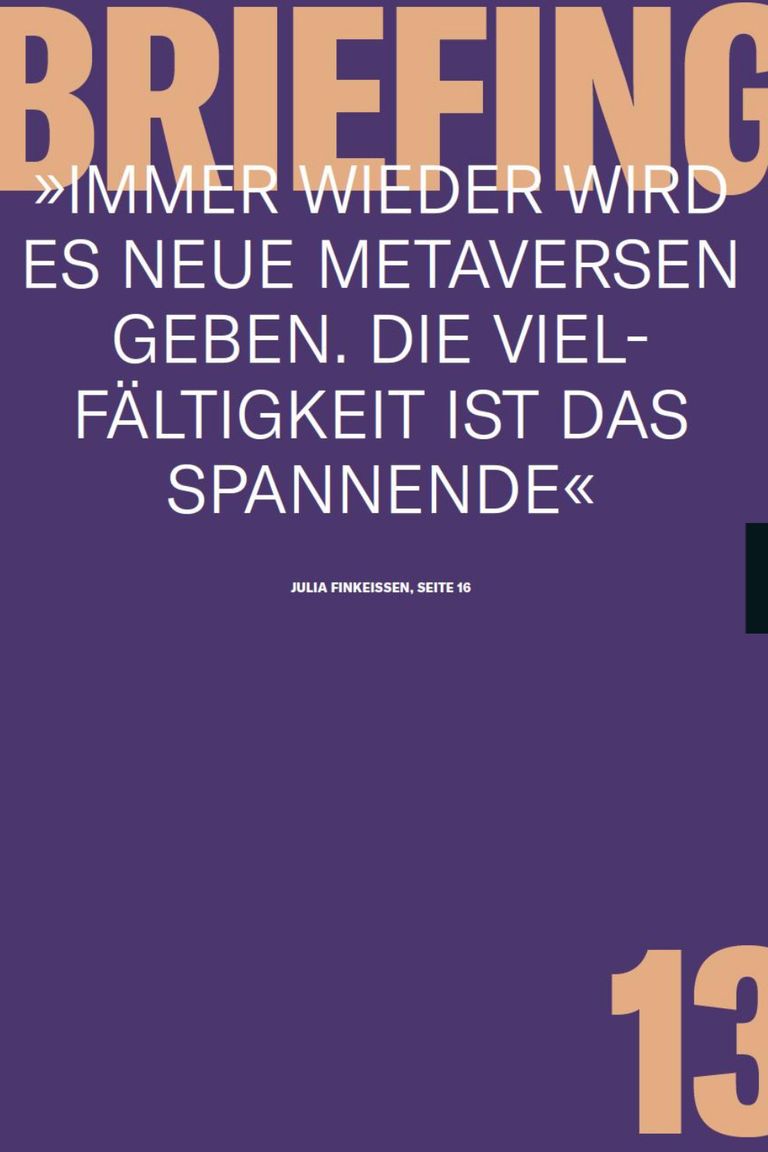
Meta verse
"Chefsache Metaverse", Campus, 2023
My book together with Co-author Thomas Koehler, published in January 2023 by Campus Verlag:
"Chefsache Metaverse. NFT, Blockchain, AR, VR: How to navigate the Web3 safely - A practical guide for companies".
The next big thing!
Metaverse - Mega Opportunity?
In 2021, the Facebook Group announces its renaming to "Meta". What initially sounded like a simple name change could revolutionize not only the Internet, but also the entire economy. Companies such as Adidas and the retail giant Walmart have already set up their first stores in the Metaverse. Car manufacturer Audi is working on the Metaverse for passengers. And that is just the beginning.
Internet experts Finkeissen and Koehler explain the most important building blocks of the metaverse and Web3 in an easy-to-understand manner. They provide concrete recommendations for action for companies and describe the new opportunities and risks of the metaverse and the underlying technologies - without false hype and always with a view to benefits and application potential.
The first Metaverse practice book for companies.


It is time for a new generation of leadership to cope with new challenges and new opportunities, for there is a new world to be won.
JOHN F. KENNEDY
Have the courage to follow your heart and your intuition; they somehow already know what you truly want to become.
Steve Jobs